What happened
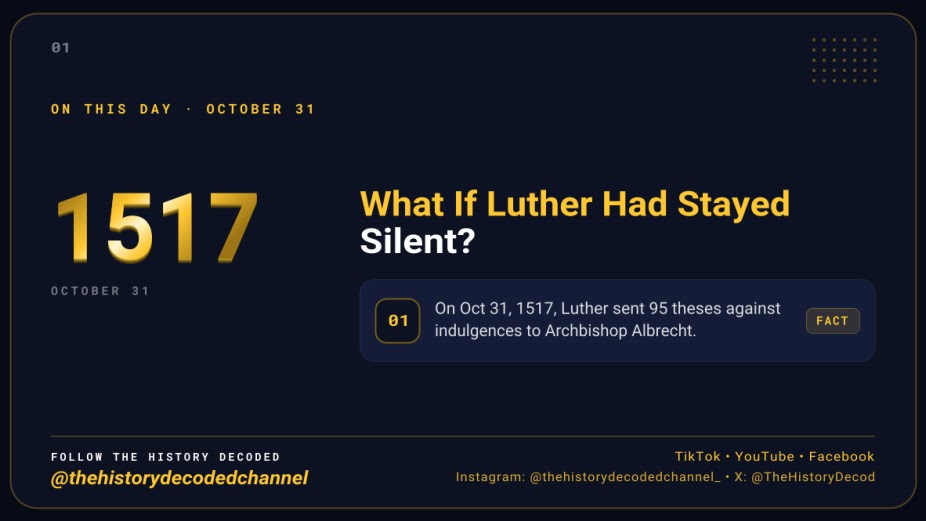
On October 31, 1517, a monk and theology professor in the small university town of Wittenberg, in Saxony, sat down to write a letter. Martin Luther addressed it to Albrecht of Brandenburg, the Archbishop of Mainz and Magdeburg, one of the most powerful churchmen in the Holy Roman Empire. With the letter he enclosed a list of 95 short propositions, written in Latin, about indulgences.
Indulgences were, in the teaching of the time, a way for the Church to remit the temporal punishment due for sins. In 1517 they were also a source of money. Indulgences were being preached and sold in Albrecht's lands, and part of the proceeds was meant to help pay for the rebuilding of St. Peter's Basilica in Rome. Luther believed the way they were being sold was wrong and misled ordinary believers, and his 95 theses set out his objections point by point.
Generations of schoolbooks describe Luther nailing the theses to the door of the Castle Church in Wittenberg that same day. Historians still debate whether that happened. The first account of the nailing was written after Luther's death by people who were not there to witness it, and Luther himself never described it. Posting academic theses on a church door was also a normal way to invite a scholarly debate in a university town, so even if it happened it may not have seemed remarkable at the time. What is documented is the letter to the archbishop, which survives.
The moment of decision
Luther had options. He could have kept his doubts to lectures and private conversation, as many critics of Church practice did. He could have written to a local superior and let the matter rest. Instead, he chose to put his objections in writing and send them to the archbishop who was responsible for the indulgence campaign, asking that the practice be examined.
Several writers on the period stress that Luther did not see himself as a revolutionary in 1517. His own later recollection was simply that on All Saints' Day he first began to write against indulgences. He seems to have expected an argument among scholars and churchmen, not a break with Rome. The decision that mattered was to take a public, written stand at all, and to direct it at the top of the indulgence campaign rather than at its edges.
What could have happened instead (a hypothesis)
Any answer to a "what if" question is speculation, and this one is no exception. Still, it is possible to sketch what was at stake. Had Luther stayed silent, or had his theses remained an internal academic document, the controversy over indulgences might have stayed a local quarrel among theologians in Saxony. Criticism of Church practice was not new in 1517, and earlier critics had been contained, ignored or condemned without starting a continent-wide movement.
What made 1517 different was what happened next: the theses were copied, translated into German and printed by others, apparently without Luther's direct involvement. Britannica notes that they became known throughout Germany within a few weeks. Without that printing, it is plausible that the debate would have moved at the speed of handwritten letters, and that Church authorities would have had more time to settle it quietly. That is a hypothesis, not a fact, and many historians would add that the political and religious tensions of the time made some kind of upheaval likely sooner or later, with or without Luther.
What actually followed
Luther did not stay silent, and the printers did not either. Within a year, more than a dozen printed editions of the theses had circulated, many of them in German. The dispute escalated from a question about indulgences into a much wider argument about authority, scripture and the role of the Church. Luther was eventually excommunicated, and the movement that grew around his ideas, and those of other reformers, became what we now call the Protestant Reformation.
Interestingly, treating October 31, 1517 as the starting date of the Reformation is itself a later tradition, which became established long after the events themselves. But the date has stuck, and Reformation Day is still marked on October 31 in many Protestant communities.
Why it still matters
The story of the 95 theses is often told as the story of one brave man. It is also a story about technology. A single letter became a public debate because a relatively new medium, the printing press, could copy it faster than anyone could suppress it. Five centuries later, it remains one of the clearest examples of how a new way of spreading information can turn a local argument into a turning point for a whole continent.
It also shows how fragile big turning points can be. A different choice by one person, or a slower spread of a few pages, might have changed the timing and shape of everything that followed. That is exactly why historians still argue about it, and why it is worth asking the question: was the Reformation driven more by Luther's ideas, or by the printing press that spread them?
Sources
- Britannica: Ninety-five Theses
- Pray Tell: Did Luther really nail 95 theses to the chapel door on October 31st?
- Deutschland Museum: Martin Luther and the 95 theses
Instagram: @thehistorydecodedchannel_ · X: @TheHistoryDecod
#TheHistoryDecodedChannel